

Ranchi
Home • Where We Work • Jharkhand • Ranchi
Ranchi, the capital city of Jharkhand, has been undergoing a rapid transformation since the formation of the state. More and more people from the hinterland are migrating to the city in search of a better life. Owing to a 23% (2001-2011) surge in population, the city administration has been encountering logjams on multiple civic fronts— public transport and mobility being major concerns for the city of 1.2 million residents.
The city’s transport system is caught in a transitional phase, with the public transport still fledgling. Filling in the void are unregulated intermediate public transport, such as shared auto operators. Our report pinned the usage of share autos at 28%, whereas bus operation constitutes a meager 5% of the modal share.
As Ranchi prepares for course correction, we have been providing its technical expertise to the city officials since 2013. Well-averse of sustainable mobility challenges and opportunities, we are evaluating the course taken upon by the Ranchi Municipal Corporation. In addition, the Ranchi Mobility Partnership was formed with multiple civil agencies, with us at the helm, to check the scope for sustainable transport intervention in the city.
We believe that creating Healthy Streets—streets that prioritise walking, cycling, and access to public transport—will not only improve road safety but also reduce greenhouse gas emissions, improve access to economic opportunities, and create a people-friendly city for all.
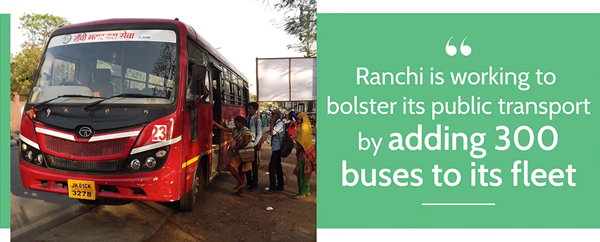
Since buses play a pivotal role in building sound transport systems, the corporation procured 70 city buses, under the JNNURM. In 2017, the civic agency added another 26 GPS-enabled buses to the fleet.
Based on the finding of the Mobility For All study, the Jharkhand Urban Development and Housing Department is working to add another 300 standard buses to meet the demand.
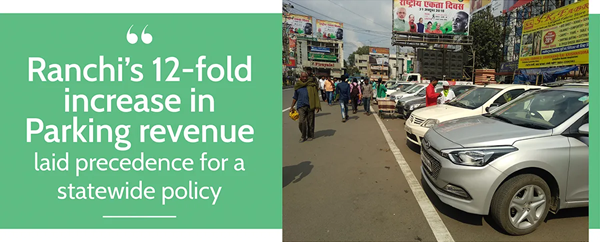
According to official estimates, the city was losing out on a chunk of revenue due to lax parking regulations and management. In 2017, the Corporation implemented a pilot smart parking management on the chock-a-block Mahatma Gandhi Marg or Main Road stretch.
Charging at a per hour basis, the results were staggering as it reduced congestion and most importantly, ensured a twelve-fold annual increase in revenue.The success of the pilot became a proponent for parking management and work is underway to make it a statewide regulation.
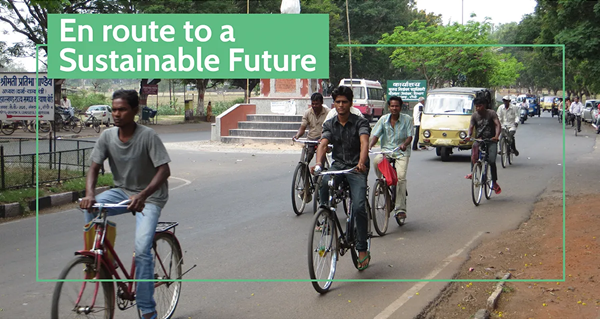
To build on its 8% bicycle modal share, the State Urban Development Agency ascertained that a bicycle sharing system in Ranchi could help maintain that number. The system that is under construction will offer 1,200 cycles, with 120 docking stations and an initial coverage area of 11.5 sq km.
To address the transport woes of its citizens, the corporation recognised smart, innovative, and sustainable solutions to reverse the status quo. These resolutions gave a leg up to the city in its bid for the Smart City Mission, for which it was shortlisted in 2016. Keeping the principles of transit-oriented development as its primary objective, the city’s transport proposal, reviewed by us, focussed on infrastructure that supported pedestrians, cyclists, and public transport systems.
The process to build a city from the ground-up is a tedious one and Ranchi is all set to be in for the long haul. To its credit, the city has chosen the sustainable mode to reach its destination.
Related Resources

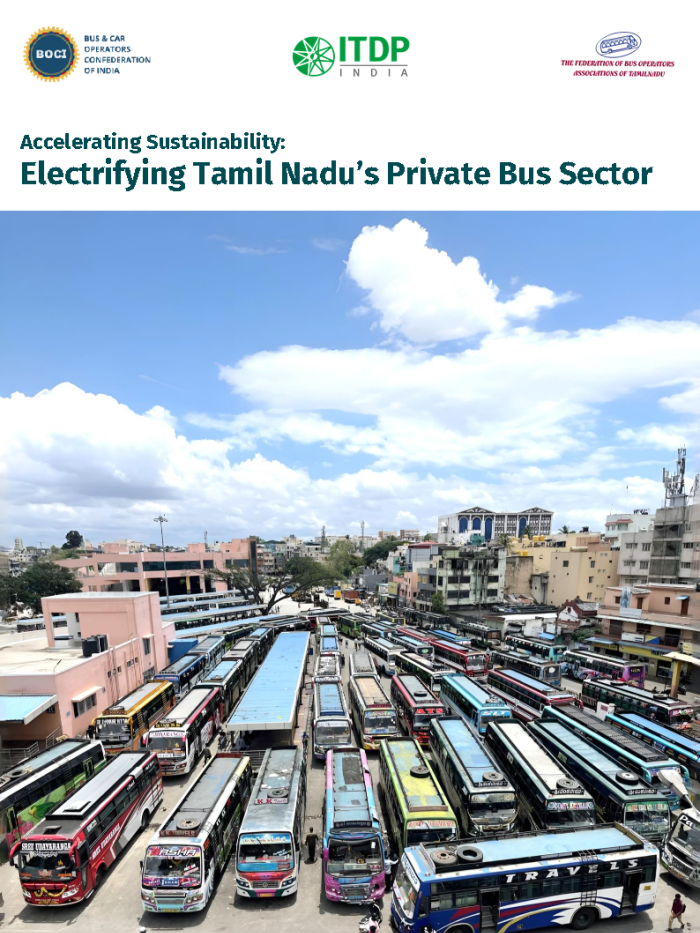
Accelerating Sustainability: Electrifying Tamil Nadu’s Private Bus Sector
Nagpur Urban Streets Assessment
Chennai's Perception of Premium Bus Service
Steps to Sustainability
Related News

Chennai enroute to humanising streets through better design
March 15, 2019
Strides towards Smart Cities in India : The Complete Streets Framework Toolkit
February 26, 2019
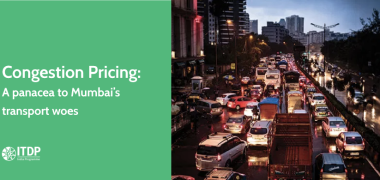
Congestion Pricing: panacea to Mumbai’s transport woes
March 7, 2019