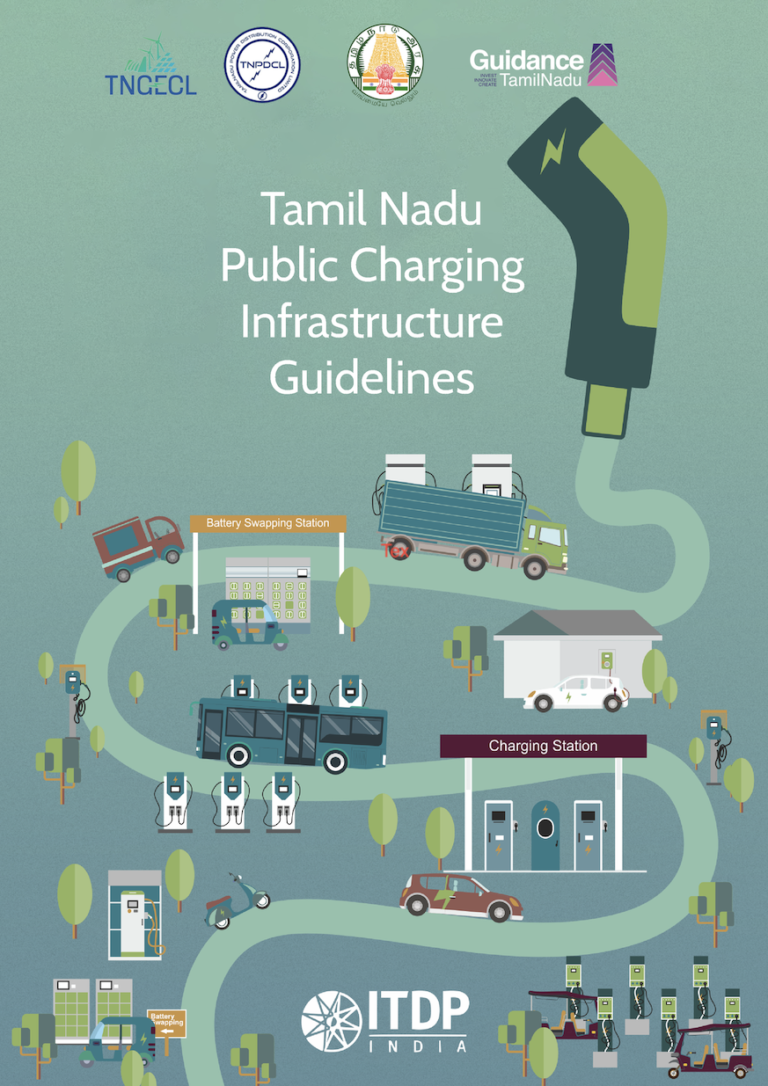
The Tamil Nadu Public Charging Infrastructure Guidelines marks India’s first comprehensive state-specific framework to guide the setting up of public electric vehicle (EV) charging infrastructure. The document has been jointly developed by the Government of Tamil Nadu’s Industries Department, Guidance Tamil Nadu, Tamil Nadu Green Energy Corporation Ltd (TNGECL), Tamil Nadu Power Distribution Corporation Ltd (TNPDCL), with technical support from ITDP India.
The guidelines provide a structured reference for future EV infrastructure planning and implementation across both urban and regional areas. One can find the following topics covered in the guidelines-
- Spatial site identification
- Regulatory norms and standard
- EV charging infrastructure demand assessment
- Public-private collaboration opportunities
- The technical and safety standards.
This resource is intended to support policymakers, urban planners, and operators by offering clear guidance on the planning, deployment, and management of EV public charging infrastructure in Tamil Nadu.
The 30-page pocket version of the Guidelines can be accessed in English.
For the Tamil Pocket Guidelines.