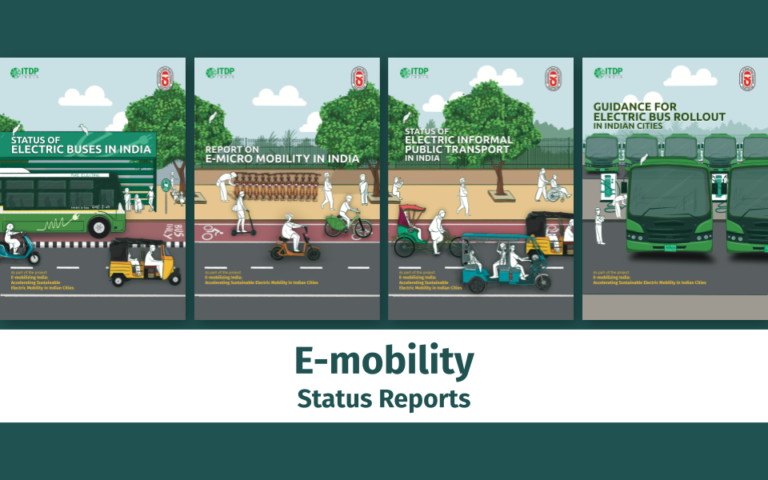
Guidance for Electric Bus Rollout in Indian Cities offers a guide for any State Transport Undertaking in India to plan, operate and monitor the operation of ebuses. It also talks about the various aspects of financial models deployed across the world for the procurement and financing of buses.
Status of Electric Buses in India aims to provide the status of the e-buses across cities and discuss their experience. E-buses have been adopted before India in some countries, hence, this report also discusses the global experience. Since the e-bus is a new and emerging technology, it is essential to understand various aspects of e-bus, battery and charging technology as well as the charging strategy, which is covered comprehensively in this report.
Many Indian cities rely on informal public transportation systems (IPT), which serve as feeders to mass transit and fill gaps. Status of Electric Informal Public Transport in India aims to provide the current status of IPT e-rickshaws and addresses the role of stakeholders in promoting sustainable IPT practices while also examining growing vehicle technology and IPT developments.
Micromobility solutions such as bicycles and scooters – electric and non-electric – offer a great alternative to address first and last-mile connectivity, air pollution, noise pollution and congestion. Report on E-Micro Mobility in India also talks about the policies and initiatives to promote e-micro mobility in India.